Showing posts with label history. Show all posts

Thursday, September 8, 2011

I'd Feel Better About A Four-Leaf Clover

As announced last June, Notre Dame will be honoring the first night game to be played in the Big House by wearing "throw-back" uniforms:

Paying homage to the rich football tradition of Notre Dame football, the Irish "Under the Lights" adidas uniform includes a white jersey with Kelly green lettering and two Kelly green shoulder stripes, old gold-colored pants, white socks with green stripes and white shoes. A large shamrock logo appears on the traditional gold helmet for the first time since the early 1960s. The years the Fighting Irish won National Championships are listed inside the bottom hem of the jersey. 
A picture of the retro-helmet was recently tweeted by @NDFBEquipment -


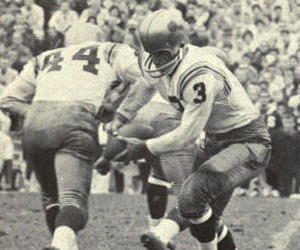
I saw some comments on the web earlier this week where some were objecting to the "new" helmets, saying that they preferred the "traditional" solid gold helmet.  It seems to have been lost on the audience that this shamrock helmet IS PART OF Irish history.  Mulling it over, I recalled that Blue-Gray Sky had done a retrospective on Irish uniforms at some point, so I thought I would dig that up and post the link here, since BGS isn't active anymore.  Which sucks.


As an added bonus check out this piece, and this piece from Helmet Hut which have more detail on the shamrock helmet.
   
Now don't get me wrong - my first reaction upon seeing the shamrock helmet was "Ewww."  But I'll keep an open mind until Saturday night.  And if the team plays well, I'll be demanding they wear the same helmets all season.


Saturday, September 11, 2010

The Gipper


I'm a Notre Dame alumnus, a huge Fighting Irish fan, and heck, I even write a Notre Dame football blog. I've seen Knute Rockne, All-American and Rudy. So I always figured I had a decent understanding of, and the proper amount of respect for, the history of Notre Dame football. But a recent coast-to-coast plane trip provided me the excuse to finally dig into The Gipper: George Gipp, Knute Rockne, and the Dramatic Rise of Notre Dame Football, which has been sitting in my stack of books to read for a few weeks. I'm glad I packed it in my bag, because it was thoroughly enjoyable, extremely educational, and it made my trip across the country jammed into coach class much more bearable (not that I ever fly in other than coach).

The Gipper, written by Jack Cavanaugh and published by Skyhorse Publishing, focuses on the improbable and inscrutable life and career of George Gipp, but really covers the intertwined Notre Dame careers of Gipp and his famous coach, Knute Rockne. I was astounded by how much I didn't know about Rockne, Gipp, and college football in general in the early twentieth century.

Notre Dame was a very respectable football program before Knute Rockne became the coach. In the ten seasons prior to Knute being named head coach, Notre Dame's record under four different coaches was 66 wins, 7 losses, and 5 ties, for a winning percentage of .878, which is just shy of Rockne's .881 winning percentage over 13 seasons. Notre Dame had already burst onto the national scene with its historic win over Army at West Point in 1913, which featured quarterback Gus Dorais throwing the ball to end Knute Rockne in a historical display of passing proficiency which truly changed the way football was played from that day forward.

But it was the ascendancy of George Gipp as Notre Dame's star player and the promotion of Knute Rockne from assistant to head football coach that took Notre Dame football to the next level. When Rockne first became Notre Dame's coach, during Gipp's second varsity season in 1918, a typical crowd at a big game would be 5,000 fans at standing-room-only Cartier Field. In Rockne's final season, 1930, Notre Dame opened a new 54,400 seat stadium on campus and played Army at Soldier Field in Chicago in front of a crowd estimated at 110,000 fans. And, of course, as the fame of the Fighting Irish grew, so did the reputation of the University of Notre Dame which has sought since Rockne to achieve recognition and respect for its academic accomplishments while it nevertheless embraces the fame and the financial rewards that accrue to its football team.

The Gipper covers what is known of George Gipp's life growing up in Laurium, Michigan and all his exploits as a Notre Dame football player and sometime student. Ample coverage is given to Gipp's very sporadic academic pursuits as well as his expertise as a billiards player, card player, and gambler. And the author tries to sort the fact from the fiction of Rockne's "Win one for the Gipper" speech and Gipp's tragic death. As amazing as Gipp's statistics and performance as a football player are, I was even more amazed by how easily it apparently all came to him. He rarely practiced football, and normally reported for the season at the last minute, if not a week or two late. He was a talented baseball player who was actively sought after by multiple major league franchises and was the best pool shooter in Northern Indiana. He broke a leg near the end of his first varsity season, and scored a key touchdown in his final game, against Indiana, after suffering a dislocated shoulder and a broken collar bone.

In addition to providing a real education about two Notre Dame legends, The Gipper offers real insight into what college football was really like in its infancy. The lax academic standards, the Sunday pro games played under assumed names, players playing at West Point for four years after exhausting eligibility in All-American careers at other schools. The 1918 season that was almost entirely canceled due to a nationwide flu epidemic. Michigan's campaign to keep Notre Dame out of the Western Conference (forerunner to the Big Ten) and to blackball Notre Dame from playing Western Conference teams. All are covered here in an entertaining, easy to read presentation that fans of Notre Dame will love, and that all fans of college football history will appreciate.

Friday, September 10, 2010

Purdue Review and Muck Fichigan (IBG Week 2)


Her Loyal Sons hosts the Irish Blogger Gathering for this week. I've been on the road for work this week, putting in some long hours in the office, and my blogging has predictably suffered. Who the heck schedules any sort of actual work between September 1st and the Super Bowl anyway? It's anti-American in my view.

So I want to put down a few very quick thoughts on the Irish win over Purdue in Coach Brian Kelly's first game.

The Irish beat Purdue by 11 points, making the wise guys in Las Vegas look pretty darn wise. I had predicted a 14-point win, so I was pretty close. But the game was actually closer than the final score indicated. The Irish only out-gained Purdue by 36 yards (358 to 322). Each team had 20 first downs.

The things I saw that I really liked included an obviously improved ground game (Armando Allen was solid at 5.2 ypc, Cierre Wood was eye-popping at 8.3 ypc), and a generally solid bend-but-don't break defense that also managed to generate some pressure on the quarterback. Purdue's longest play from scrimmage was a 23-yard scramble by the quarterback. The longest run by a non-QB was 14 yards. The longest Boilermaker pass play was just 16 yards. The Irish sacked Marve 4 times. The final really good thing was a very solid special teams performance that contributed greatly to the Irish win in the field position battle. Notre Dame's ASFP (Average Starting Field Position) was it's own 33-yard line. Purdue's ASFP was the 22-yard line.

Dayne Crist's stat line was "fine." 19 of 26 for 205 yards, 1 TD and zero INT. I don't know how things go in your house, but in my house if my wife (or my daughter) tells me that something is "fine" that's not synonymous with "good." "Fine" is synonymous with "not at all fine, and you better figure it out and fix it mister or there's gonna be trouble later." It wasn't all on Dayne, as his receivers dropped several catchable balls. But Dayne had quite a case of Brady Quinn-itis going on, allowing his adrenaline (or something) to severely affect his accuracy. I am going to chalk it up to first-start jitters and hope there are no second-start jitters. Thank goodness for Kyle Rudolph who appears in the early going to be Crist's security blanket. Michael Floyd and Theo Riddick need to step it up against Michigan, and of course catch and hold onto the ball. Between the drops and three fumbles, the ball was on the ground way too often in game one. And a safety? Really? I trust that's the last we'll see of that.

All in all, a "good " start for the Irish in the Kelly era. Better than "fine," but not great.

Now a quick, but pithy contribution to this week's Irish Blogger Gathering


1) You've now seen Notre Dame Football: The Kelly Edition, Volume 1, Episode 1. Was it everything you thought it would be? Were characters missing from this episode that you were expecting to see featured? Did it strike you as a carbon-copy of Kelly's Cincinnati teams, or is there something discernible between the 2 programs beyond the colors of the uniforms?

It was not everything I thought it would be, as discussed above. I never felt like the passing game was truly "clicking", although the success in the running game was a bit of a surprise. I hope we'll see more from Theo Riddick this week. If he doesn't step up, opponents will shut down M. Floyd and dare you to find another way to beat them.

Was it a carbon copy of Cincinnati? Seriously? What Notre Dame fan has ever watched a Bearcats game? I haven't seen more than 5 minutes of Cincinnati highlights that I pulled off You Tube once. I only watch football that matters.


2) Pick one positive play, offense or defense, by the Irish from last Saturday that you feel serves as a bit of metaphorical foreshadowing for the 2010 Irish. Extra points if you can stretch the metaphor to fit Kelly's entire tenure at Notre Dame.

Man, you piled the words metaphorical, foreshadowing and tenure into this one question. I guess we know who the English major is.

Okay, here's your play. Score still tied 0-0 in the first quarter. The Irish have had the ball twice, punted twice. Armando Allen is the featured back and has had runs of 4, -2, 1, and 4 yards and one reception for no gain. Purdue is in Irish territory and driving, when Darrin Walls intercepts a Marve pass at the Irish 16. The Irish offense takes the field, with Cierre Wood at running back in relief of Armando Allen. On the first play of the drive, Cierre Wood takes the hand-off and slashes his way up field for 16 yards and a first down. He follows up with a 15-yard rush on the next play, and also adds another 15-yard run later in the drive. To cap the drive Armando Allen scores a TD on a nifty 22-yard drive that had a lot more energy than any of his carries before Wood entered the game.

Metaphorically, Cierre Wood's first carry was an injection of youth, energy, and talent into the the Irish offense that picked the team up and propelled it to a touchdown and, ultimately, to victory. This foreshadows the injection of youth, energy and talent in the person of Coach Kelly and the players he will bring into the Irish program.


3) Pick another play, offense or defense, by the Irish from last Saturday again, but this time, make it a negative play. Tell us how that play serves as a bit of metaphorical foreshadowing for the 2010 Irish. And again, bonus points for stretching it over Kelly's tenure.

Is it too easy to pick Michael Floyd's great catch and run, followed by his horrible fumble that cost the team a touchdown and put the outcome of the game in doubt?

That was a foreshadowing of the growing pains that we will see for much of 2010. We'll see flashes of brilliance, signs of great potential, and then we'll see flashes of failure, signs that we aren't ready to be champions yet. We saw all that on just that single painful play.


4) You know us, we're stat geeks. Give us a stat that we should be watching this season that will A) Tell us something enlightening about the 2009 Irish and/or B) Tell us something enlightening about the average Top-5 teams at the end of the 2009 season.

I love Average Starting Field Position (ASFP). It tells you a lot about the hidden yardage within a game. A team that takes care of the ball and makes few mistakes will generally win the AFSP battle, and they will usually win the game. Against Purdue, as noted above, the Irish won the ASFP battle by 11 yards (the 33 versus the 22 yard line). That's a fairly sizable margin, and that's why the Irish won by 11 points even though we barely out-gained the Boilers and both teams had 20 first downs. Turnovers is arguably the most important stat in football, and special teams play is the most under-appreciated. ASFP usually reflects a team's performance in both these important areas.


5) Notre Dame is currently a 4 point favorite in the coming Michigan game. You get 3 points for being at home. The AP poll actually ranks Michigan higher than ND. ND is 1-4-1 in the last 6 games with Michigan in which the Irish were favored and 9 and 6 in the last 15 games in which Michigan was favored. Does any of this worry you? Why or why not?

Let's see. Last November, with Irish QB Jimmy Clausen passing for 329 yards, UConn beat Notre Dame 33-30 in double OT in Notre Dame Stadium. One week ago, Michigan whipped UConn 30-10. So therefore Notre Dame is favored to beat Michigan this week by 4 behind a young QB making his second start.

Makes. No. Sense.

I'd prefer to be the underdog against UM any time. But I doubt that Coach Kelly is going to let the boys be over confident going into this game.


6) Last week, Frank at UHND put the Gathering on the spot with our predictions for the season. After week 1, are there any of those predictions that you'd like to alter? Any upon which you'd double down?

Clearly I was giving the Big East and Pittsburgh too much credit. I had Pitt ending the season as the highest-ranked Irish opponent, and I had their running back Dion Lewis winning the Heisman. Pitt has serious QB problems, which allowed Utah to just pack the box against them and stuff Dion Lewis. Lewis is in for a long season.


7) Describe in no fewer than 30 words why you hate Michigan.

Over the summer there was much discussion about a major re-alignment of college football, and many felt that Notre Dame could not survive as a relevant, national football power if it remained independent. So-called experts have repeatedly opined that it was obvious that Notre Dame should join the Big Ten. What most commentators fail to understand is that Notre Dame is independent for one reason, and one reason only: The University of Michigan, under a succession of football coaches and athletic directors, led a conspiracy fueled by anti-Catholic bigotry and jealousy which aimed to keep Notre Dame out of the Western Conference (forerunner of the Big Ten) and to discredit Notre Dame as a University and as a football program. Notre Dame became an independent and America's college football team playing coast-to-coast because the other universities in its own back yard refused to respect them enough to put them on the schedule. Given the long and inglorious history of despicable treatment of Notre Dame by the members of the Big Ten generally and Michigan particularly, Notre Dame should not EVER consider joining the Big Ten until the members of that conference issue a formal, public apology to Our Lady's University.

More on the ugly history of Michigan's treatment of Notre Dame can be found here:

http://www.domerdomain.com/forum/showthread.php?t=30904

Monday, August 2, 2010

Dusting Off the Crystal Ball


Happy August to all of you! It's been a little slow around here at OC Domer, but I've been busy with my day job and just couldn't bring myself to write yet another story about not-very-bright students getting arrested by not-very-bright Indiana law enforcement officials for underage drinking at an off-campus party. My thoughts on the situation haven't changed a bit since my last rant on the topic in September of 2008.

The only thing I would add is this: Coach Kelly, you obviously still have a lot of work to do to to in teaching your players the right way to conduct themselves. And yes, I do hold the football team, who are attending the University on full scholarship, to a higher standard than I do the rest of the student body. To me, this incident also shows a lack of leadership on the team. Were there no upper-class players there who were willing to tell the underage players that they needed to put down the alcohol and drink the un-spiked punch instead? A lot of work to do.

But back to the crystal ball. I am getting ready to begin the arduous process of writing the OC Domer Pre-Season Spectacular post for 2010. In doing so, I went back and dusted off my pre-season predictions for the past several seasons (since the inception of the blog), and the results were so hilarious that I had to share them with you. The point of this exercise is to hopefully give you a good laugh, and to also serve as a slap across the face to me that will hopefully knock off my rose-colored glasses before I make any predictions for 2010.

2007 Predictions:

Final Results: With young but talented players all over the field, and with new defensive coordinator Corwin Brown, the Irish basically win the games they won and lose the games they lost in 2006 (UCLA being the exception). But we don't get blown out by anyone. We aren't a Top 5 program yet, but at 10-3 overall, we end up just outside the Top 10 in the final polls of the season. Entering 2008 we are a Top 10 team fighting to become an elite Top 5 program.

Conclusion. So, this is how I see the season playing out. Is it a prediction? Not really. It's just a thorough explanation of where I see the program and what I think I'm going to see. Might Charlie's Fighting Irish exceed my expectations? They could. The offensive line could be dominant, the QB play spectacular, the young receivers amazing. The front seven could be energetic AND stout. We could beat Michigan and UCLA, we might even surprise everyone with an improbable win over the Trojans. On the other hand, the O-line might not be what we need it to be. The young QBs and receivers might sputter. The front seven might give up too many yards in the running game. If that happens, we could lose to Georgia Tech, Penn State, MSU and BC. It could be a disaster. But, as one sage once said "That's why they play the games."
2007 Actual: 3 wins against 9 losses. Blown out by Georgia Tech (33-3), Penn State (31-10), Michigan (38-0), USC (38-0), Air Force (41-24). A triple-OT loss to Navy. The only wins against UCLA, Duke, and Stanford. A total, unmitigated disaster.


2008 Predictions:
Final Thoughts. Do I really think Notre Dame will finish the 2008 season 11-1? No. While I sincerely believe the Irish could, or even should, win each of their first 11 games, I also expect that a team as young as the Irish will have some untimely penalties and turnovers, or just come out flat, and let a couple of games get away from them. Counting the likely loss to USC, I expect nine wins, give or take one. Of course, a lot has to go right for nine wins to happen. But after last year I figure the Irish are due a little luck.
2008 Actual: 6 wins against 6 losses in the regular season, plus a nice win the the Hawaii Bowl to end our bowl game losing streak. This team was all over the map. Strong wins over Michigan, Purdue, Washington. Awful losses to North Carolina, Boston College, Syracuse. Only an impressive bowl win over Hawaii saved Charlie Weis' job.

2009 Predictions:
I do pick Notre Dame as the favorite to win eleven of its twelve regular season games. Does that mean I think they will go 11-1? I certainly hope so, but that's where the "confidence" ratings included for each game factor in. Using the confidence ratings and a little math you can get a better idea of what outcome is more likely for the season win total, just like the guys in Vegas. Adding together the confidence ratings I assign to each game:

.80+.70+.60+.75+.90+.40+.70+.90+.75+.65+.75+.75 = 8.65 wins

Depending upon where you look, I've seen over/under win totals for Notre Dame set between 8.5 and at 9.0 wins, which is right in line with my own estimations as set forth above. I may be more optimistic or pessimistic than you, but I encourage you to try this yourself. Assign your own confidence values to each Notre Dame game and see what your personal over/under is for 2009. For me, 9 wins is what the Irish "should" achieve in 2009, all things being equal. If they earn less than nine wins, they have under achieved and only a very, very nice Bowl win would bring Coach Weis back in 2010. If they manage to win ten games, they will have beaten the odds in my view, and the extra win would have to be credited to Coach Weis who will have earned the chance to stay on as coach. If they win eleven or twelve, that would be a superior job of coaching and you'll need dynamite (or another year like 2007) to dislodge Charlie from the Gug.

What do I think will really happen? I bet the over. And got 25-1 odds on the Irish winning the Championship.
2009 Actual: 6 wins and 6 losses, including four losses in a row to end the season against Navy, Pitt, U-Conn, and Stanford. Adios Charlie.

Conclusion: I cannot be trusted to evaluate the fortunes of the Notre Dame football team. For 2007, 2008, and 2009 I predicted the team would win 9, 9, and 9 regular season games, which translated into 3, 6, and 6 actual regular season wins on the field. Not very impressive. But I'll give it a go anyway later in the month. Don't say you weren't warned!

As an aside, I challenge all my Irish blogging brethren to post their past prediction performance along with their predictions for 2010, so we can have total transparency, just like the Obama administration.

Wednesday, June 30, 2010

Happy Hour

My previous post on the personnel changes in the Office of Residence Life at Notre Dame generated a few comments. Some reminded me that the folks at "Res Life" are good Notre Dame people who are just trying to do their jobs enforcing the rules. That's fair enough, but while I am not questioning the good intentions of the recently departed, I do reserve the right to question the manner in which they exercised their discretion and their authority.

Other comments were more in the nature of dancing in the streets. The recently retired Notre Dame Leprechaun (no, really) asked if students got "res-lifed" in my day? In "my day"? What the heck is that supposed to mean junior? I'm not THAT old. Am I? Get off my lawn you dang kids. By the way, you should check out the Leprechaun's new blog, Irish Creed, when you get a chance. Great perspectives from a couple of newly minted ND graduates and one current senior.

But seriously. Yes, students did get "res-lifed" back in my day. But you had to try just a little bit harder than today's students to get in serious trouble back in the early eighties. The story below should help contemporary readers understand where I and my peers are coming from when we bemoan the draconian approach the Administration has recently taken toward discipline generally, and alcohol in particular. The story is taken pretty much verbatim from a post I wrote several years ago over at Verminnet.com, a web page for Carroll Hall alumni. I'll admit that our experiences in Carroll Hall were not necessarily in the middle of the mainstream back then, but we weren't that far out of the norm either.

The story is called "Happy Hour":

I arrived at Notre Dame and Carroll Hall in August of 1982, having come all the way from California, alone. The bus from O'Hare dropped me and my trunk at the main circle, and I needed some help to find out where Carroll Hall was. I had seen it on the campus map the University sent me, and it seemed like it was sort of far from the rest of the buildings on campus. I didn't know the half of it. I was literally living a dream being able to attend Notre Dame, but I was a little bummed with the dorm I got.

No worries. I carried/dragged my trunk from the main circle all the way to Carroll, and the RA's greeted me and showed me to my room. It was a big cube of a room on the first floor, right across from the rector's office. My roommates were three New Yorkers (geeeeeez). John "Basil" Hayes and Jock Brody Mutschler were both from the Rochester area, and Scott Kiley was from Long Island. Basil, Jock, and myself were Navy, Army, and Air Force ROTC respectively. Scott was not the military type. Neither was Jock for that matter, but that's another story.

The most striking feature of our room was the plush wall-to-wall whorehouse-red carpet that we had inherited from the previous occupants. Those previous residents had dubbed the room "The Love Palace" and the name stuck, although I'm not sure we really deserved the tag. With four of us living there, and the rest of the Vermin wandering through because of our central location, it wasn't really a quiet place for getting to know that special someone. It might have been called the Insomnia Palace. I swear we never got a wink of sleep before 3:00 a.m. that whole year.

At any rate, I settled in with my new roomies. Before long, a couple of big bruisers came through the door and started demanding money from each of us. Turns out these were some seniors in the dorm, and they were collecting cash for the Happy Hour set for that Friday. I don't recall exactly, but they wanted $5 or $10 from each of us. At the time, that was a lot of money for me. My parents had me on a $50 per month allowance, and I hadn't been picked up on my ROTC scholarship yet. Plus, I wasn't much of a drinker, and I wasn't sure I wanted to go to some party. How naive I was. But these guys weren't taking "no" for an answer. After the shake down was over, some other dorm vets clued us in on what the Happy Hour was all about.

Here's the premise: On weeks of home football games, all during the week in classes, etc... you invited every desirable (or near-desirable, or at least breathing) girl you met to come on out to Carroll on Friday afternoon for our Happy Hour. Good music, free booze (and lots of it). A good time to be had by all. Chicks come, chicks drink, chicks get happy, maybe guys get lucky. The Carroll Happy Hour had a good reputation in some of the girls' dorms, and amazingly enough come Friday afternoon, the dorm was rocking! When you walked back up the drive to Carroll after Friday classes, the music was blasting across the lake. Inside (and often out on the front lawn as well) the kegs had been tapped and the beer was flowing. Inside, there were at least two bars set up. One was usually serving blender drinks (Sea Breezes made with ice, vodka, 7-up, and some sort of juice concentrate), the other was something else (I can't remember because I was usually working the Sea Breeze bar, and performed quality control as well.). These parties started at maybe 3:30 or 4:00 in the afternoon. They would die down a bit as dinner hour came, and then as people left for the pep rally. But they usually went on at least at a low level until about 2:00 a.m. on Saturday morning (I think Parietals kicked in at 2:00 a.m. on the weekends, so the ladies had to leave at that time). Although the first floor was the epicenter of the action, the Happy Hour really encompassed the entire dorm. Some partied in big groups downstairs, other partied in more intimate groups on floors two through four.

I remember vividly one scene from my first Happy Hour. I was standing in the party room on the first floor, just down the hall from my room, talking to one of the RA's. He was drunk off his ass, leaning against the wall to hold himself up. He was looking a little ragged, and was quite a bit overweight. And he was passing on a little bit of wisdom. "I used to be like you. In shape, great high school athlete. But before long, you'll look like this too." He was commenting on the crop of young, naive, fresh-faced, super-fit freshman that had just joined the Hall. We thought the guy was pathetic and crazy and bitter. Little did we know.

The Happy Hour was the focus of social life in Carroll Hall, and it gave us our identity. It wasn't always pretty. Lots of guys (especially the freshman) got way too drunk and out of control or sick. Hijinks were common (water drops? Pizza heists? Often post-Happy Hour entertainment). Nicknames were earned. The best example of this from my group of friends was Steve (Last name withheld to protect the sloppy drunk), who was from Texas. One Friday afternoon, during a particularly good Happy Hour, a group of us decided that we wanted to go to the pep rally, and Father Steve was going to take us over to Stepan Center in his van. At any rate, sometime between leaving the dorm for the rally, and returning afterwards, Steve got very sick and blew chunks everywhere. Chunks. The name absolutely stuck. While people later meeting him might assume that "Chunks" got his name from being kind of chunky (he was a big guy), we all knew how he really got the name. Do you remember the show Cheers? When Norm walks in? "NORM!" everyone shouts. Everywhere Steve went for four years, his fellow Vermin would greet him with a chorus of "CHUNKS!"

Many of the stories posted on VerminNet have some connection to the Happy Hour. Of course, nowadays the University would consider our behavior reprehensible. Well, they did then too, but we were pretty much out-of-sight, out-of-mind, and Father Steve was very lenient with us.

I believe it was in my Junior year (1984-85) (Father Steve's last year as rector) that the University killed the Happy Hour. New University policy that year essentially prohibited any alcohol consumption by students under 21 (although they would tolerate drinking in your room behind closed doors if you didn't draw attention to yourself). Alcohol consumption at dorm parties was limited to 21 and older, and was relatively strictly enforced.

It was the end of an era. We held a funeral for the Happy Hour. Father Steve let us borrow some vestments, candles, etc.. from the chapel. We had a last party, and then we laid the Happy Hour to rest. We had a funeral procession, some words were said. And a couple bottles of booze along with some mementos were buried in a hole out behind the dorm. We even had a headstone with "R.I.P." on it. I don't know if the headstone or the grave is still there. I doubt it. But I know there are people out there in cyberspace with pictures of the event, and I think I've got a commemorative button in my trunk somewhere (the same trunk after all these years).

Wednesday, January 27, 2010

Thoughts on Coach Kelly


My Dad reminded me a few weeks ago that I hadn't yet chimed in with my opinion on Brian Kelly being hired as the new head football coach at Notre Dame. He was right, as he often is, but at the time I didn't really have anything intelligent to add to the conversation beyond "Yippee!" I wasn't surprised by the hire, as loyal OC Domer readers will recall that I confidently posted here on November 18th that his hiring was "all but a done deal." And of course I am extremely pleased that Athletics Director Jack Swarbrick targeted and landed a coach who was arguably the most qualified candidate he could have possibly lured to South Bend and a man who is easily the best prepared head football coach Notre Dame has hired since Lou Holtz.

To me, Coach Kelly perfectly fits the model that has produced National Championships for Notre Dame in the past. As I wrote during the long November of 2009 when we were all waiting for the curtain to come down on Charlie Weis' tenure at ND:

For me, the preferred model is the one that has made Notre Dame most successful in the past. Hire a coach who has been a very successful college head coach elsewhere. Find a guy who has displayed a knack for over-achieving at a "lesser" program, of doing "more" with "less." Frank Leahy was very successful at Boston College before coming to Notre Dame. Ara Parseghian won at Northwestern. Dan Devine won at Arizona State and Missouri. Lou Holtz won at William & Mary, North Carolina State, and Arkansas.
I don't think people truly appreciate how important experience and sustained success as a head coach is as a predictor of future success. People tend to think of Ara Parseghian as a young "up and comer" that we snatched away from Northwestern. But did you know that Ara was the head coach at Miami University for five years and at Northwestern for eight season before landing the Notre Dame job? That's thirteen years of incredibly important experience in the top job before coming to ND. Dan Devine had spent three years as head coach at Arizona State, thirteen years as head coach at Mizzou, and four years as head coach of the Green Bay Packers before coaching under the Golden Dome. That's twenty years as a head coach in Division I and the NFL. Lou Holtz's head coaching career before Notre Dame included three years at William & Mary, four years at N.C. State, one year with the N.Y. Jets, seven years at Arkansas and two years at Minnesota. That's seventeen years as a head coach before leading a team into Notre Dame stadium.

Contrast the above list of Championship coaches with this list: Gerry Faust (No college head coaching experience prior to ND); Bob Davie (No head coaching experience prior to ND); Ty Willingham (Seven seasons HC at Stanford); Charlie Weis (No college or Pro head coaching experience).

When looking at what has worked versus what hasn't worked historically at Notre Dame it should be painfully obvious that if you want to have a reasonable chance of football success you must hire a coach with significant experience as a head coach. Even Ty Willingham's seven years of HC experience at Stanford wasn't enough to prepare him for true success at Notre Dame. On the other hand, Brian Kelly's twenty years as a head coach at Grand Valley State, Central Michigan, and Cincinnati makes him more experienced than either Holtz or Parseghian and puts him on par with Dan Devine.

Take that twenty years of experience, give it to an Irish Catholic kid from Boston who has always dreamed of coaching at Notre Dame and who is a bundle of energy and seemingly a natural motivator and leader, and you have to expect that good things are about to happen for Notre Dame football.

So, to answer my Dad's e-mail, I'm pretty pumped about the beginning of the Brian Kelly era at Notre Dame.

Having had the time to sit back a little and watch as Coach Kelly has gone about the task of retooling the Irish football program, I do have some initial impressions that I would like to share.

Players. Coach Kelly has his own definite notions of the type of players he wants in his program. He calls them RKGs (Right Kind of Guys). He wants young men who are football players. Not necessarily the most gifted or talented guys, but guys who love the game and who will work hard to be prepared to play hard on Saturdays. He wants guys with heart and passion and work ethic and discipline. He wants guys who want to be at Notre Dame and who really, really, want to wear that gold helmet and play for the Fighting Irish. He wants guys he can trust to be selfless and committed to the team and to their teammates. Prima donnas need not apply. I think he wants Rudy, but with more size and 4.4 speed.

Of course, not every 4-star and 5-star prospect will fit the RKG mold. Many of the most talented players choose their college with one eye focused on a future NFL career. Sure, they want to win. But it's at least as much about them as an an individual pro prospect as it is about the team. It's about making highlight reel big hits rather than a sure tackle. It's about the big breakaway run rather than putting your head down and getting a first down. It's about not getting hurt rather than going all out on punt coverage.

Notre Dame is already limited in the pool of 4- and 5-star recruits we can really pursue due to above-average academic standards. That pool is clearly going to be narrowed a little bit more as Coach Kelly and his staff weed out players who are not RKG material. We may not see it this year as Coach Kelly nails down a recruiting class that was mostly selected and secured by Coach Weis' staff, but in February 2011 I think Irish fans are going to be very surprised by how the pundits rate Coach Kelly's first true class of recruits. I expect that class to be rated much lower than Charlie Weis' classes have been. Part of it will be the result of the RKG test discussed above. But a larger part will be that Coach Kelly has his own very strong opinions about the types of athletes that will perform best in his system.

I'll discuss it more below, but Coach Kelly has a very definite system and style of play that he coaches. He wants to recruit RKGs who will get the most out of his offensive and defensive system. He does not believe that Scout.com or Rivals.com are as good at evaluating prospective players as he is. If he really likes a tackle for his offense who is "only" rated a 3-star prospect, he is not going to lose sleep over it. If the 3-star guy is a better fit than available 4-star guys, he'll take the 3-star guy. I think we'll see this play out all over the depth chart, on both sides of the ball.

Now, this isn't to say that future Notre Dame recruiting classes are going to look like recent Cincinnati classes. Clearly Coach Kelly will have access to a bigger, more talented pool of RKGs than he did at Cincy. But where Charlie Weis' recruiting classes were generally Top-10 caliber and even Top-5, I fully expect Coach Kelly's classes to be in the second ten (ranked 11-20) rather than Top 10.

Not that there is anything wrong with that. One of the great laments for Irish fans in recent years (as during the Gerry Faust years) is that we keep bringing in highly touted recruiting classes, but it isn't translating into wins on Saturday. So what is happening? Are the coaches failing to develop the players to their potential? Are the players not working as hard as they should? Are the folks at Rivals.com and Scout.com who rank these players full of baloney?

I think one of Coach Weis' problems at Notre Dame was that he was prisoner to the star system. Certainly when he first arrived it was important to him to create the impression that Notre Dame was on the way back. One quick way to do that is to land some big recruits, create some buzz, and use that buzz to land more big recruits. And it worked, at least on the offensive side of the ball. Bringing in Jimmy Clausen certainly helped land other talented skill players. But were all these guys good fits for Charlie's system? Were they RKGs? Were they really as talented as their star ratings? I think Charlie paid too much heed to the star system and I think he lacked Coach Kelly's confidence in his ability to evaluate the college potential of high school football players.

So after several seasons of watching highly ranked recruiting classes under-perform on the field, I am more than willing to try another approach: Taking less-heralded RKGs and seeing them get coached up so that they over-perform on Saturday.

Coaches. Let's face it, Charlie Weis never really figured out how to evaluate and hire good coaches. Having never been a head coach, and not having any college coaching experience, the pool of guys he could draw on to join his staff based on personal relationships was small. So he had to rely on the recommendations of his NFL buddies on who would be good hires. And maybe these guys were good coaches. But they had never coached with Charlie, and they came from different systems, and in my view it never really came together as a full staff. I think the offensive staff this past season was (finally) excellent. But the Tenuta/Brown experiment on defense didn't work. The inexplicable loyalty to John Latina as O-line coach was, well, inexplicable. I don't want to dwell on it, but I file it under "lessons learned" that hiring an all-star hodge-podge of guys with no common experience is not the way to build a staff.

Coach Kelly has gone another direction. With a few exceptions his new Notre Dame staff is a group of guys that have coached with or for him before, in some cases for many years. These guys know each other, they trust each other, they know the system and trust the system. They are on the same page and pulling in the same direction from day one. (Cliche' alert!) They aren't big names or all-stars. They don't have much NFL experience. They are career college coaches who have won championships with Coach Kelly before, and who expect they will do so at Notre Dame.

The relative lack of name recognition and complete lack of Super Bowl rings will probably make recruiting just a little more challenging. But Coach Kelly isn't as worried about recruiting as he is about what happens to the players once they arrive at Notre Dame. He wants coaches who he knows can teach his system and who he knows can develop young high school players into the best college players they can be. He believes this staff of coaches will do that.

System. Through twenty years of learning and growing and evolving as a head coach, Brian Kelly knows who he is and he knows what type of football he wants to play. He has a system. It isn't an exotic or gimmicky system (although it may seem a little exotic to Notre Dame fans at first). It's a fully developed, established and de-bugged philosophy and playbook on both offense and defense. On offense they run a wide-open spread attack that features footballs flying all over the yard. On defense they run a base, balanced, aggressive 3-4.

In sharp contrast to Coach Weis' philosophy of trying to out-scheme opposing teams ("schematic advantage" anyone?), Coach Kelly's goal is to have his players learn his system inside and out and then out-play (out-execute) opponents. Rather than trying to find and exploit individual match-ups to win games, Coach Kelly is in effect telling opponents "This is who we are, this is what we do. Good luck stopping us." It reminds me of the Notre Dame teams under Lou Holtz. Under Lou everybody knew we were going to run the option or hand the ball to Jerome Bettis. Stopping it was another matter. Bill Walsh's 49er teams led by Joe Montana were similar. Opponents knew what plays the 49ers were going to run. But the plays, if executed properly, put so much pressure on a defense that they were impossible to stop.

Having a clear system has several advantages. First of all, as discussed above, it allows you to be very precise in targeting recruits that fit your program. If you are a spread offense you need nimble offensive linemen and versatile running backs who can run routes and catch the ball. Giant tackles who can drive block but who can't move laterally, or fullbacks who can't catch the ball out of the backfield are not good fits, so you don't pursue those guys. On the defensive line, you need big guys that can anchor that 3-4 defense, not pass-rushing defensive ends who can't stand up and play linebacker. Having a clear philosophy and system on both sides of the ball allows you to focus on finding RKGs that are the best fit for your program.

Second, having a clear system gives players a sense of identity and therefore a sense of confidence. They know who they are are. They know what their role is. They know what they are supposed to do. The fundamentals of the system stay the same from the time they enroll as freshman until they are getting significant playing time as juniors and seniors. Practicing the same fundamentals, the same techniques, the same playbook over a course of several seasons breeds confidence, it breeds trust in the system and in their teammates. it allows players to react on the field without having to think about it, it allows players to play faster with fewer mistakes. I'll talk more about it below, but having a familiar system that is consistent from week to week and from year to year leads to what Coach Kelly calls "unconscious competence", which means that you have become so adept that you know what to do and how to do it without even having to think about it. It becomes second nature.

Compare the above concept of an established system with a defense that changes each year from a 3-4 (with 4-3 personnel) to a 4-3, and then back to a 3-4, and that changes defensive coordinators every year. Or an offense that is experiencing a competition at quarterback among four players who are inexperienced in the base offense while trying to also install a gimmicky "wildcat" offense that will hopefully "surprise" the opening day opponent. Do you think those players are gong to be thinking a little too much on game day? Is it any wonder the O-line played in slow motion on opening day 2007 against Georgia Tech? In retrospect, to a lesser degree one has to wonder if Charlie's attempts to out "X" and "O" opponents by devising a clever new game plan every week just slowed the guys down by forcing them to think too much, rather than just executing with confidence.

Development. Listening to his press conferences and reading his interviews, it is clear that Coach Kelly believes that the way to win football games is to develop players. Not recruit players. Develop players. He believes in developing them as players on the field, and as people off the field, in the classroom, and in the community. I'll be focusing here on development as players on the field.

All the topics I discussed above tie into the concept of player development. Getting the Right Kind of Guys (RKGs) who are passionate about the game, and who are disciplined and committed and willing to work hard to become better players. He hired a coaching staff of guys he knows to be great teachers and great at helping young men reach their full potential. And he has an established system which is designed to lend itself to and reinforce the development of players.

I have heard Coach Kelly mention the concept of "unconscious competence" more than once. It's an odd phrase and one that I was not familiar with, but it seemed to be fundamental to his coaching philosophy, so I looked it up. It isn't a new concept, but it is a powerful learning model that one can easily see would lend itself perfectly to teaching football. If you look it up you'll see these concepts referred to variously as the "conscious competence ladder" or the "conscious competence model" and so forth. I found one web page that did the best job of explaining the concepts fairly succinctly, so I'm going to borrow liberally from it below, but I encourage you to go read the full article at MindTools.com if you want more information.

The conscious competence model is a conceptual way of looking at the transition from a state of blissful ignorance of a skill to mastery of that skill. It can be applied to almost any endeavor, but I'm going to look at it in the context of football.
Level 1 - Unconscious Incompetence (You Don't Know that You Don't Know)
At this level you are blissfully ignorant: You have a complete lack of knowledge and skills in the subject in question. On top of this, you are unaware of this lack of skill, and your confidence may therefore far exceed your abilities.

[COMMENT: Think about that freshman running back who dominated every game he ever played his whole life and who thinks he knows all there is to know about being a running back and that he will excel as a college back from Day 1. He has no idea how little he really knows and how much he needs to learn to play at this level]
Level 2 - Conscious Incompetence (You Know that You Don't Know)
At this level you find that there are skills you need to learn, and you may be shocked to discover that there are others who are much more competent than you. As you realize that your ability is limited, your confidence drops. You go through an uncomfortable period as you learn these new skills when others are much more competent and successful than you are.

[Comment: Think about the freshman running back who gets into Fall practice and realizes he isn't the fastest or strongest guy on the field anymore. He is having trouble reading the defense to run in the correct hole or figure out who to block. He keeps getting tackled for no gain in the scrimmages and run over by linebackers in drills.]
Level 3 - Conscious Competence (You Know that You Know)

At this level you acquire the new skills and knowledge. You put your learning into practice and you gain confidence in carrying out the tasks or jobs involved. You are aware of your new skills and work on refining them.

You are still concentrating on the performance of these activities, but as you get ever-more practice and experience, these become increasingly automatic.

[Comment: Following good teaching and coaching and repetition in the familiar system, the young running back learns how to read the defense, how to find the hole, who to block and how to block them. Now he's ready to get on the field on Saturday.]

Level 4 - Unconscious Competence (You Don't Know that You Know - It Just Seems Easy!)
At this level your new skills become habits, and you perform the task without conscious effort and with automatic ease. This is the peak of your confidence and ability.
[Comment: Now the young running back can spot the holes and pick up the blitzer without having to think about it. It's automatic and second nature. Now the player can let his natural abilities and instincts flow, and he'll be playing fast and with incredible confidence.]

It seems obvious once you read through it. And once you understand the learning model, you can see how important it is that the players are being developed within an established system. In order to play fast and with confidence, the players have to get to level four - unconscious competence. They can only get there if they get enough practice and repetitions in the fundamentals of the system to make their play reactive and automatic. Any time the coach changes the system, or introduces a new series of plays or a new defensive concept, all the players get knocked back down to level 2, conscious incompetence, and have to work their way back up to level four. With good coaching they will get to level 3, conscious competence, within a reasonable period of time. But only with a sufficient number of repetitions and practice will the team get to level 4 on the new concepts.

Under NCAA rules the coaching staff only gets so many practice hours with the team each season. They can only squeeze so many reps into that time. A choice has be made, a balance struck, between how much playbook is installed and what percentage of the time will the players be playing with unconscious competence. It is clear that Coach Kelly places a premium on running a more limited, but known system extremely well rather than installing a more diverse playbook that the players can only execute at level 3, conscious competence.

Conclusion. Having watched Coach Kelly from my perch out here in California, I have been very impressed. His enthusiasm is palpable, and from his opening press conference I had no doubt that his players will be fired up and ready to run through walls come September. Hell, I'm ready to button my chin strap and go play. I've still got four years of eligibility to burn!

But as I've examined his moves and tried to get inside his head, he is even more impressive. He is completely ready for this challenge. Not only does he know football. It's clear from the discussion of "unconscious competence" above that he has been studying leadership and psychology and teaching for the past twenty years and he is fully equipped to take the young men who choose to go to Notre Dame places even they don't realize they can go.

Welcome to Notre Dame Coach Kelly! Go Irish!

Sunday, August 16, 2009

Taking Care of Business


Coach Charlie Weis' season opening press conference was very interesting to me, particularly because it is clear that Coach Weis and I see the 2009 season in much the same way. The soundbite from the press conference that received the most attention, on the theme of expectations, was:

There's a lot of things going into this year that I'd rather not say because I'd rather get it done on the field. That's really one of the main deals or goals going into training camp, is, Fellas, don't tell me about expectations, show me.
Just a few days before Charlie's "show me" remarks, I wrote the following about 2009:
If we have learned nothing else the past two years, we have learned this: No matter what we see or hear about how things are going at practice in August, fans will know nothing about this team until they take the field for real in September. [...] We know this team has the POTENTIAL to be great. But until they line-up on a Saturday, we have no inkling of how they WILL play.
In other words: Show me.

So while it's mildly interesting to watch all the videos at UND.com with practice highlights and interviews from players and coaches, I find that my patience for pre-season hype and talk is worn very thin.

All I want to know about the Fighting Irish for 2009 is: Will they take care of business this season?

What do I mean by "taking care of business?" It is playing consistently at a high level. It means winning in convincing fashion over lesser opponents, and playing very competitively against top teams. The pain of 2007 and 2008 was not so much the games Notre Dame lost to better teams. There is no shame in losing to a better opponent. No, the real pain of 2007 and 2008 was losing games that, despite not having our best talent level, we still should have won.

It was clear early in 2007 that Notre Dame was going to have a very difficult year. Getting hammered by Georgia Tech (33-3), Penn State (31-10), Michigan (38-0), and Michigan State (31-14) in the first month (that's a combined score of 133-27) was sufficient to drive home that reality for even the most optimistic of Irish fans. While losing game after game to quality teams was tough, we became numb to all but the most bitter of defeats. In 2007 it was the losses to Purdue, Navy, and Air Force that were really hard to swallow. In the Universe of the die-hard Notre Dame fan, there just isn't any alignment of the stars that can explain how the Irish can lose those games.

In 2008, there were several painful losses, but the worst were the three games that the Irish lost after they had comfortable leads and were apparently entirely in control of the outcome. Blowing the games to UNC, Pitt, and Syracuse (and turning a pretty darn respectable 9-3 regular season into a mediocre 6-6). Those three losses are the most glaring 2008 examples of the inconsistency that is the Hallmark of NOT taking care of business, but they weren't the only examples. Week 1 of 2008 was a win against San Diego State that was much too close for comfort, and which actually required a 4th quarter Notre Dame comeback to avert disaster. The SDSU debacle was somewhat overshadowed by a blow-out win over Michigan the following week, but in retrospect we should have recognized it as an early warning signal.

We tend to forget it in the disappointment of the last two seasons, but there is ample evidence that Coach Weis' is capable of fielding teams that do take care of business. The 2005 team was impressively consistent. A big opening win over Pittsburgh in Coach Weis' debut, followed by a win over Michigan. After a tough overtime loss to Sparty (I hate those guys), the 2005 Irish won 7 of the next 8 games by about 20 points per game, the only loss being the 4th & 9, Bush-push game to USC (34-31). No messing around with Navy and Syracuse in 2005. That was taking care of business, and even the Fiesta Bowl loss to Ohio State was closer than folks remember. That game was 27-20 OSU with 5:27 left in the game, and that was after a Tom Zbikowski fumble return for a touchdown was called back.

Weis' 2006 team lost only to Michigan, USC, and LSU - three very good teams. But they took care of business against everybody else. No close calls (or losses) to Purdue, Stanford, Navy, Air Force, Army ...

Which brings us back to 2009. The Irish open up the season against the University of Nevada, which feels a lot like last year's opener against SDSU. What will the 2009 squad show us? Will it be a replay of the close call against the Aztecs, foreshadowing more immaturity and inconsistency to follow? Or will it be more like the opening blow-out win of 2005 which set the tone for an entire year of play at a consistently high level?

With Michigan waiting in the wings, the game against the Wolfpack might not look very important. But from where I sit it is huge. If this Notre Dame team can establish in week 1 the ability to be focused and intense no matter who they are playing; If they can block out the looming Wolverines, and NOT play down to the level of their opponent; If they can take care of business and dismantle the 'Pack without conscience - then it will bode very well for 2009. If not, then we can all buckle up for another unwanted roller-coaster ride.

Much has been said and written about the 2009 Notre Dame schedule. The fact is, most Irish opponents this season are either weak teams or are expected to have down or rebuilding years. If the Fighting Irish can be focused and mature this year, they have the experience and the talent to take care of business and win a lot of games. The question is: Will they? We'll know a lot more about that on September 5th.

Bonus Content: Are you looking for a low-pressure yet enjoyable fantasy football league to play in for 2009? The OC Domer FFL is looking for owners. Click here for details.

Need Tickets? If you need tickets for any 2009 Notre Dame football game, please visit our sponsor, NotreDameTickets.com and give them a chance to earn your business.

Sunday, September 21, 2008

Dear Fr. Jenkins: Jesus Changed Water to Wine

I'll write about Notre Dame's disappointing day in East Lansing soon enough. But something else needs our attention. It seems that nearly every law enforcement agency in the state of Indiana has decided that alcohol consumption by college students is the top enforcement priority in the state. It seems that the SUDS task force (Oh, that cop humor!) swooped down upon an off-campus party late last night and arrested 37 Notre Dame students for underage drinking, including two football players. Whew! I feel much safer now! Because we know the streets of South Bend are free of violent crime. Rape, muggings, burglary, murder - none of that in St. Joseph County!

Now, don't get me wrong, if a student party off-campus is too loud and is disturbing the local citizenry, it's fair to call the cops and break the party up. If anyone gets obnoxious with the cops rather than running for the hills, then arrest them. But to have a multi-agency task force swooping in and arresting dozens of students is ridiculous. College students drink. College students have been drinking in and around Notre Dame and South Bend since approximately 1842. Living out here in California, I don't understand what has transpired to make this such a perceived threat to public safety. Has the President of the local MADD chapter been elected Mayor of South Bend?

I was a student in the mid 1980's when the University drastically changed the alcohol policy. Up until then, dorm parties featuring plenty of adult beverages was the norm. Heck, they were rites of passage. Under the old rules, there was no need to EVER go off campus looking for a party. All you had to do was step out into the hallway outside your dorm room. The new rules generally prohibited drinking by students under 21, although if you were drinking alone in your room behind closed doors they would generally ignore it. (Brilliant policy!). So of course all underage drinking by ND students came to a halt. NOT!

The parties moved off campus, a long way from the safety of the dorms, with predictable results. The neighbors have to deal with more loud parties. No RAs or dorm rectors to keep a lid on things. Students now have to worry about the Inidana State Police taking them off to jail. And if the cops don't show up, inebriated students have to find a way back to their dorm rooms. They can stumble along dark, dangerous South Bend streets or they can catch a ride with one of their slightly less hammered buddies. Brilliant!

I have a daughter who hopes to attend Notre Dame someday soon. Ask me if I would rather she go to a party and have a couple of beers in the common room of her dorm or in an apartment in a lousy neighborhood off campus? It is no contest that I'd rather she attend the party in her dorm. Isn't this obvious to Father Jenkins and the rest of the University leadership?

I guess what bothers me the most is how the University (both UND and other universities) is a moral coward on this issue, while being the champion of moral virtues on other issues. Stand up against Catholic teaching and the Church by hosting the Vagina Monologues and encouraging a week of tolerance for the LGBTQ community at Notre Dame? Absolutely! Many schools thumb their noses at the Federal government by banning ROTC from campus. Protests for and against anything (abortion, war, drugs, hunger, radical environmentalism, communism) are de riguer on campus. But when it comes to beer, the University curls up into the fetal position and mumbles something about "liability" and the law. The University is willing to "stick it to the man" in the name of political correctness. But not in the name of its students. It wasn't always that way.

As for the football players. I am disappointed that members of the football team weren't a little more upset by the loss to Michigan State. If the team had won the game, then they should be out partying. Or preferably on campus partying. But after a tough loss I would think the team would keep a lower profile and get some sleep. As for Wil Yeatman, if it turns out that he really was caught drinking again, he's an idiot. I'm sure his reinstatement to the football and lacrosse teams (not to mention his deal with the Indiana judicial system) included a very clear understanding that he would not drink underage anymore. By putting himself in a situation where he will likely never play varsity sports at Notre Dame again he really let down all his teammates.

Tuesday, August 12, 2008

A Nostalgic Look Back at August 2007

When I was in school, I had a soft cover edition of the Merriam-Webster dictionary with a tie-dyed, psychedelic 70's era cover. My kids use Dictionary.com. The Dictionary.com definition of nostalgia is: "A sentimental yearning for the happiness of a former place or time." The 2008 Notre Dame football season is almost upon us, and we are accordingly seeing in the blogosphere the traditional precursors of every football season: Pre-season predictions. Reading this year's crop of predictions and forecasts brings to mind a few thoughts.

  • First, I need to write my pre-season predictions post.
  • Second, I need to get a life.
  • Third (and the point of this post), I wonder how last year's crop of predictions held up?
I think it's essential to remind ourselves that no matter how earnestly we analyze the nuances of the recently released depth chart, how closely we watch the scarce practice video available, and how meticulous we are in reading the tea leaves on our opponents' off-season development, we know NOTHING about how the year will unfold. Until we see Armando Allen stiff-arm a defender and take it to the house, we don't know if he'll be better this year. Until we see Golden Tate catch a ball in traffic on a perfectly timed square-in route we won't know if he's picked up the offense. Until we blow the opposing D-line off the ball on 3rd-and-3 for an easy 1st-down conversion, and see the O-line pick up the zone blitzer and give J.C. plenty of time to deliver the ball to a receiver running wide open down the seam, we won't know if the O-line has matured sufficiently to give the Irish a real chance to win this season.

To satisfy my curiosity, I set the Wayback Machine for August 2007 and went back to see how my favorite bloggers did in forecasting how the 2007 Notre Dame football season would unfold.

I'm not going to exempt myself from this exercise. I wrote two fairly detailed posts last season on how I thought the season would unfold. The first post looked at my general overall expectations of the team, the second looked at my expectations for the Irish on a game-by-game basis. Looking back at last year's pre-season posts, there was good news and bad news for OC Domer. The good news is that I did a pretty good job of identifying the fact that the team's fortunes would depend on improved offensive line play:
Which brings us to the offensive line. I think most Irish fans are in agreement that the play of the O-line last season was pretty underwhelming. How often did we see Brady Quinn making plays with defensive linemen or blitzing linebackers breathing down his neck or draped over his back? Far too often. How many times, on fourth-and-short, did Notre Dame run a QB sneak? If your best power running play in short yardage situations is the QB sneak, your O-line is not getting the job done. How many times did Darius Walker make a spectacular run in just getting back to the line of scrimmage rather than taking a three-yard loss?

We don't have Brady Quinn at quarterback any more. We don't have Darius Walker, who could see disaster coming through the line and side-step it like a matador. We have three inexperienced quarterbacks who will need time to throw the ball. If they aren't given time, we will see interceptions, fumbles, and sacks. We have largely inexperienced running backs who will need actual holes to run through. If those holes aren't there, we'll see negative-yardage runs and fumbles in the backfield.

In short, Notre Dame's fortunes this year are riding on the offensive line. We have to be able to reliably run the ball for 4 yards or more on first and second downs. We can't be in third-and-long situations. Third and long means an all-out pass rush, with young running backs trying to pick up the blitzers, and a young QB throwing the ball down field to young receivers trying to find a soft spot in the nickel or dime zone defense. That is not a high percentage situation. We have to be able to mix pass and run as we choose to, not have it dictated to us by the down-and-distance situation. On short yardage, we don't want our young QBs running the sneak. We want to give the ball to TT, or Schwapp, or Aldridge, or Hughes and know that we can get two yards. Obviously, in the passing game, the QB will need more time to throw than Brady Quinn had last year. If the offensive line can control the line of scrimmage, if the Irish can run the ball with authority rather than finesse, then I think we can have a very good year.

But John Latina had better make sure his resume is current. Because if the O-line fails to produce this year, he will be next year's Rick Minter.
The bad news for my 2007 pre-season analysis is that I thought the O-line would get the job done. In my game-by-game analysis I had the Irish putting up another 10-win season (including the Bowl victory):
At 9 wins and 3 losses, the Irish don't get selected to go to a BCS Bowl, and instead get to play in a respectable bowl game against an opponent they can beat. Having solved our big-play problems on defense, and having healed up from the brutal first eight weeks of the schedule, Notre Dame handily wins it's first bowl game since New Year's Day of 1994. [...] With young but talented players all over the field, and with new defensive coordinator Corwin Brown, the Irish basically win the games they won and lose the games they lost in 2006 (UCLA being the exception). But we don't get blown out by anyone. We aren't a Top 5 program yet, but at 10-3 overall, we end up just outside the Top 10 in the final polls of the season. Entering 2008 we are a Top 10 team fighting to become an elite Top 5 program.
Not to tip my hand too early, but my pre-season forecast posts for 2008 will likely be equally as absurd in their optimism as last year's posts.

How did everyone else do in August 2007?
  • The crew at Blue-Gray Sky put their predictions in a handy chart for us. The most pessimistic prediction was for an 8-4 season, the most common prediction was 9-3, and a couple of contributors had the Irish at 10-2 and one at 11-1 (regular season).
  • Blue-Gray Sky ran a pre-season reader poll that got over 2,000 responses (I'm not worthy!). Roughly 75% of respondents thought Notre Dame would win 9 or more games, with only 25% predicting 8 or fewer wins. Only about about 2.5% of voters expected 6 or fewer wins.
  • Subway Domer had a computer crash last year that threw him off-stride for a while in August, but he was able to offer us his insights on the 2007 offensive line situation:
    This will be a very physical line and as the line goes, so will our running and passing game. [...] John Latina wants a unit that is versatile and interchangeable, and finally with depth we may have that. [...] This unit may surprise a lot of "national" media outlets. On paper they have a small amount of total playing time, but will make up for it with a nastiness that was lacking from last years unit.
  • Her Loyal Sons offered up a game-by-game breakdown of the season and concluded:
    The regular season is wrapped, and ND has surprised the CFB world by pulling off an 8-4 season and a berth in a respectable bowl. More than anything, the team matured throughout the year, and with the incoming talent is poised to make a serious mark over the next 2 seasons. A national championship in ‘08-’09 isn’t out of the question, and everyone’s expecting one the following year. Based on his preseason comments, ESPN donkey pundit Mark May votes Charlie Weis Coach of the Year, which he wins.
  • Rakes of Mallow offered a very balanced, reasonably objective analysis that put the Irish on a 9-3 regular season. Only missed it by that much.
  • The fellas at Section 29, Row 48, Seat 10 should be recognized for an outstanding 12-Day countdown to the 2007 season, highlighting 12 keys to Irish success. Their #1 concern was the battle in the trenches:
    I hope you flip over your handle bars and knock your two front teeth in! You selfish son of a B&*&H!!! You're leaving me in the trenches, taking grenades John!!!

    This quote from America's consummate Notre Dame fan, Vince Vaughn, neatly summarizes the one thing on which success hinges for the Irish - winning the battle in the trenches, and not merely from one side. It isn't only that the Irish front line defense, reduced to 3 in Corwin Brown's new scheme (Justin Brown, Trevor Laws, & Pat Kuntz) needs to succeed against great running backs over the first two months. Or that the Irish offensive line must break in three new starters and so quickly and without missing a beat in front of an inexperienced quarterback. Either of these things would prompt huge concern for the Irish coaching staff and become a point of emphasis. The fact that both are paramount at the same moment demonstrates why the battles along the trench line will make or break the Irish season.
  • The Rock Report ran another fan survey, with over 3,000 responses, and used some fancy statistical analysis to come up with an overall "fan prediction" of an 8-4 season. As for the Rock himself, he predicted another BCS Bowl appearance for the Irish.
Ah, memories! Times were simpler then. There certain things you could count on in this world. Like blocking, tackling, and beating Navy. But life is more complicated today.

So, when you read a pre-season prediction, forecast, breakdown, analysis, etc..., remember how smart we all were last August and take them for what they're worth. But by all means, go ahead and read 'em. The blogs I mention above, as well as the non-probationary blogs listed to the right are all doing great work covering the Irish pre-season and getting the Notre Dame nation ready for kick-off.

Go Irish! Beat Aztecs!

Sunday, July 20, 2008

The Case for Hope (Part 2)


The first post in this series examined the 2008 Notre Dame football schedule with a focus on new opponents for this season, and how they compared to the 2007 opponents that they replace. To recap, the money paragraph in Part 1 was:

Crunching some numbers you see right away that Notre Dame is losing from its schedule five teams with an average final 2007 Sagarin rating of 53, and is picking up for 2008 five teams with an average 2007 Sagarin rating of 76.8 (let's call it 77). Thus, on average, the new opponents for 2008 are ranked 24 spots lower than the 2007 teams they replace.
Today's post takes a very rough look at the remaining teams on the Irish schedule - those teams that Notre Dame played in 2007 that they will also play in 2008. The goal is to get some idea about the relative strength of these "continuity" games in 2008 versus in 2007. The basic method of comparison will be final 2007 rankings versus pre-season 2008 rankings, although I may throw in some comments on an opponent's pre-season 2007 rank or even rankings at the time they played the Irish when it seems especially pertinent. The giant caveat of course is that comparing pre-season predictions to end-of-year polling is a bit of an apples-to-oranges situation. Lesser caveats (I wish I could use footnotes for all the caveats!) include the facts that (a) not all the pre-season predictions are in yet; (b) those predictions that are available don't necessarily agree with one another; (c) post season polls don't always agree with each other (for example, polls and computer rankings aren't always in sync, and even the various computer rankings can be wildly divergent).

I will be relying primarily on Athlon Sports for my 2008 pre-season rankings. I like Athlon because they have a good reputation as being among the most accurate of the pre-season magazines, and because they do us all the favor of ranking all the teams from 1 through 119. (Apologies to Michigan and Ohio State fans because Athlon doesn't include the Division 1-AA teams in the National rankings). Services which offer only a "Top 25" ranking are not only lazy, but not very helpful in looking at strength of schedule. Also, my local Barnes & Noble had the Athlon National Edition on sale when I went shopping yesterday. I also picked up a copy of 2008 College Preview magazine from ProFootballWeekly.com & CollegeFootballNews.com. I'll note the CFN rankings when they vary significantly from the Athlon predictions.

For the 2007 Final rankings my primary resource is Jeff Sagarin's final 2007 computer rankings, using his "predictor" column which accounts for margin of victory. I've relied on Sagarin for years and I think his is the best computer model available. These rankings also have have the benefit of ranking all the teams, not just the Top 25 or so that we get from the AP or BCS polls. (Note to Michigan and Ohio State fans: Sagarin's rankings do include Div. 1-AA teams, so you can track the strength of all your opponents).

That's enough of the introduction already! How does the schedule look?

Michigan. The Wolverines are a bit of a mystery coming out of the blocks this season. They have lost nearly every skill position player of note on offense (including their top 2 quarterbacks), they lost their head coach, and the new coach had a rough go of it in recruiting this season and is installing an entirely new offensive system. Rakes of Mallow has a very nice post on the parallels between the 2008 Wolverines and the 2007 Irish in this regard. Added to all the turmoil is that in 2007 Michigan, even WITH all their vaunted senior leadership (Hart, Henne, etc...), was a team that started the year 0-2 with an embarrassing loss to Div. 1-AA Appalachian State (34-32) and a humbling beat-down by the Oregon Ducks (39-7), before whipping the Irish 38-0 to start an eight game winning streak and eventually defeating a strong Florida team in the Capital One Bowl, 41-35. One has to figure that Michigan will start very slowly this season. But Notre Dame doesn't catch them until UM's third game of the year (which is exactly when the Wolverines got themselves straightened out last season). As far as the numbers go, Michigan finished 2007 at #18 in the AP Poll, and #24 in Sagarin's rankings. Athlon predicts them at #28 for 2008. Michigan has a lot of talent on the roster, and they may be at #28 by the end of the season, but they probably won't be even that good on September 13th. In any case, a 28th-ranked Wolverine squad has to be considered a "down" year and a nice break for Notre Dame. By contrast UM was ranked #5 in both the AP and USA Today pre-season polls last year.

Michigan State. Because of the general disdain that the entire staff here at OC Domer feels for the Spartans, I won't spend much time on them. In 2007, MSU finished up at #39 in the Sagarin rankings, while Athlon has them at #49 in their pre-season list. (Note that the Sporting News does have Sparty at #27, and CFN has them at #41). Expect Sparty to play over their heads as usual against the Irish, but 2008 doesn't look like an "up" year for MSU. Another break for ND.

Purdue. Despite flirting with greatness last season by starting the year 5-0 (capped by a win over ND 33-19), Purdue struggled down the stretch and finished 8-5 and #54 in the Sagarin rankings. With experienced QB Curtis Painter returning, Athlon has them picking up right where they left off at pre-season #54. Basically, Purdue looks to be Purdue again this year and not cause the Irish any more trouble than usual. Given that Notre Dame actually outplayed the Boilermakers in the second half last year and had a serious chance to win that game despite some sloppy play, you have to like the Irish chances this year against PU.

Stanford. In what has to rank as one of the ugliest college football games ever played, Notre Dame beat Stanford 21-14 to close out their historically bad 2007 season. Stanford finished 2007 at #69 in Sagarin, and opens 2008 at #74 in Athlon. Bottom line is Stanford doesn't figure to be much better in '08, and the Irish do figure to be better. Advantage Notre Dame.

Boston College. I have a theory about sports. I call it the Cinderella theory. The OC Domer Cinderella Theory holds that teams can't have two "Cinderella" seasons in a row. The clock has struck 12 on the Cinderella story of 2007. The Eagles had a nice run last year, starting 8-0, finishing 11-3, coming close to both an appearance in the BCS Championship and a Heisman trophy. But the star QB (and almost everyone else on offense) is gone. BC finished 2007 at #10 in the AP Poll and #30 in Sagarin. Athlon puts them at #44 for 2008. Clearly a step back for BC in '08, and a break for Notre Dame.

Navy. The Midshipmen made some history last year by defeating Notre Dame for the first time in my life. So what are they going to play for next year? Navy finished 2007 at #77 in Sagarin, and open 2008 at #72 in Athlon. Notre Dame should avenge last year's loss and start another streak against the Middies this year.

Southern Cal. Notre Dame doesn't catch any breaks in this one. The Trojans have owned the Irish the past two seasons, and this year we play at their house, following a BYE for USC. USC finished 2007 at #3 in the AP and #4 in Sagarin. They open 2008 at #4 in Athlon's rankings. The biggest issue for USC is at QB, where new starter Mark Sanchez is unproven. But even if he stinks it up early in the year, the Trojans will have plenty of time to switch to former Arkansas QB Mitch Mustain and get him rolling before the match-up with the Irish in late November. USC will be very good. The question is whether the Irish will have grown up enough by then to make a game of it.

Conclusion. Notre Dame's schedule looks very favorable for 2008. The new teams on the schedule for '08 are significantly weaker as a group than the teams they replace from the '07 schedule. Opponents that appear on both the '07 and '08 schedules as a group are expected to take a step back this year. With the exception of USC, the teams that can usually be counted on to present the biggest challenges for Notre Dame (Michigan, Michigan State, Purdue, Boston College) all are widely expected to have "down" years in 2008. As a young Irish team looks to take the step up to respectability in 2008, having a schedule that is much more manageable than last year's gives me some real hope.

Wednesday, April 16, 2008

What's In a (Blue-Gold) Game? (2008 Edition)


The 79th Annual Blue-Gold Game will be played this Saturday afternoon in Notre Dame Stadium. Of course, the scrimmage is now part of the "2008 Blue-Gold Spring Football Festival, presented by Home Run Inn Pizza." Coach Weis has named six big-time heroes from Notre Dame's storied past to be the Honorary Coaches for this year's contest. He has also modified the format of the game a bit (offense versus defense with funky scoring), probably due to depth issues (such as at QB and TE).

However it's played, the Blue-Gold Game is always a highlight of the Spring for Irish football fans, as we've been in serious withdrawal from our steady diet of football since at least the Super Bowl, or perhaps even since the Stanford game for those who just can't get a good buzz from the NFL (the "Methadone" of the hardcore college football fan). It's also the way those serious fans finally get release from the tension that has been building up for several weeks. We know that football is going on. We've been teased and scintillated by video clips of guys running over bags, and receivers catching balls in drills, and coaches cussing at the linebackers - but we haven't been allowed even a glimpse of "our guys" playing real football, full speed, on real grass, and under the bright sunshine of a Notre Dame afternoon. The anticipation is part of the fun, but after a while it's almost too much to bear. This Saturday we'll all be able to satisfy our hunger, relax, and breathe easier. At least for a while.


If that last paragraph feels a little creepy, I think it's because I've been distracted by the whole Marilyn Monroe sex tape thing. Do you think it was really JFK?


But I digress. Every Spring, there are two categories of questions swirling around the Blue-Gold Game. The first category of questions are the "what will we see?" type question. Last year those questions dwelt on the four-horse quarterback derby (including Jimmy Clausen's arm) and on Corwin Brown's new defensive scheme. This year, we aren't expecting a lot of surprises from a depth chart perspective, many of the young players played a lot of football last year and we (or at least "I") don't expect to see a lot of "new" faces in the lineups. But that doesn't mean we don't have questions.

  • How does Jimmy's arm look? Is it finally 100%?
  • Have the young receivers (Kamara, Tate) matured enough in the offense to take the passing game to the next level?
  • Who's going to be "the guy" at RB? Can Armando Allen run through some contact and rip off some big yards?
  • How different will the defense look with the addition of Coach Tenuta to the defensive staff?
  • Do we have enough big bodies to fill out the D-line? Will the D-line be able to stop the run at all?
  • Can anybody in St. Joseph's County kick a f*&%ing field goal? A touchback?
  • And, the number one question of the Spring: Can the offensive line get the job done?
So we'll watch the game and get some tentative answers to the "what will we see?" questions. But it's the second category of question that is the most compelling: "What does it all mean?" It's tempting to say that "it's just a practice" and that you can't really put much stock in what comes out of this somewhat artificially staged scrimmage. Last year I did some digging to try to see if there was any correlation between what happens in the Blue-Gold game and what we see in the Fall. I was able to find some data back to the 1998 B-G contest, which I've included here, updated to reflect the results from 2007.
  • 2007. Gold defeated Blue, 10-6. Offensive Player of the Game, Junior Jabbie (13 rushes for 87 net yards, 0 TDs). Defensive Player of the Game, David Bruton (4 total tackles and 35-yard INT return for a TD).
  • 2006. Blue defeats Gold, 10-7 on a Carl Goia field goal. Offensive MVP was Travis Thomas (8 rushes for 104 and a TD). Defensive MVP was Trevor Laws (6 tackles, including 2 sacks).
  • 2005. Blue defeats Gold, 28-6. Offensive MVP Brady Quinn (8 of 12 passing for 102 yards, 2 TDs). Defensive MVP Trevor Laws (1 sack and 3 total tackles for loss).
  • 2004. Blue defeats Gold 35-7. Offensive MVP Brady Quinn (17 of 22, 263 yards, 1 TD). Defensive MVP Tom Zbikowski (1 INT).
  • 2003. Blue defeats Gold 17-14. Offensive MVP quarterback Chris Olsen (11 of 25, 146 yards). Defensive MVP Justin Tuck (3 sacks).
  • 2002. Gold defeats Blue 3-0 on Nick Setta field goal. Offensive MVP Ryan Grant (7 carries for 45 yards). Defensive MVP Gerome Sapp (5 tackles, 1 INT).
  • 2001. "Defense" defeats "Offense" 74-40. Is nothing sacred? Offensive MVP David Givens (2 TD catches). Defensive MVP Shane Walton (INT return for TD).
  • 2000. "Defense" defeats "Offense" 39-31. Offensive MVP Jabari Holloway (4 receptions). Defensive MVP Anthony Denman (39 yd INT return for TD).
  • 1999. Blue defeats Gold, 49-10. Offensive MVP Jarious Jackson (5 of 6 for 73 yards and a TD). Defensive MVP Anthony Denman (6 tackles, 1 INT).
  • 1998. Blue defeats Gold, 38-7. Offensive MVP Autry Denson (11 carries for 109 yards). Defensive MVP Kory Minor (5 tackles including 1 sack).
Based upon my review last year, I concluded:
Well, to me it looks like what you see is what you get. If a player has a big Blue-Gold game, he's a pretty decent player and he's likely to have a pretty good Fall season. If the offense is prodigious in the Spring, you'll probably be able to move the ball in the Fall. If the defense dominates the Blue-Gold, the defense will likely be the better unit come September. So, while you're tempted to say that the Blue-Gold is fairly meaningless, I would have to disagree. Looking back a few years tells me that teams don't change drastically over the summer. Warning signs in April are serious weaknesses in October. Strengths now will likely be the team identity in five months.
Well, that's what I said before the 2007 Glue-Gold. Did it hold up? Here was my recap of the action in last year's contest:
So, after last Saturday, a day on which the weather did cooperate, what do we have? We have a quarterback derby that is still very much in the air. Before the game, Zach Frazer was pretty vocal about being #1 in the race, at least in his own mind. Then he went 0 for 4 with a pick. Demetrius Jones was only 3 of 6 with an INT, but also threw the only TD pass of the day, and had a very nice 31 yard run in a key spot. Evan Sharpley was 5 for 7 for only 31 yards, and got "sacked" 4 times. Wonderkid Jimmy Clausen was 3 of 7 for 23 yards. As a group, the four quarterbacks were 11 of 24 attempts for a whopping 77 yards, 1 TD and 2 INTs. You'd have to say nobody set Rock's House on fire from the quarterback spot.

On the ground, contrasted with just 24 passing plays (by the QBs), the Blue & Gold squads ran the ball 44 times for a net 211 yards, averaging 4.8 yards per rush (excluding QB runs and sacks). The combined squads had 12 first downs via the ground, only 2 converted through the air. The offensive surprise of the day was Junior Jabbie, who had more than twice as many yards as any other rusher (net 87 yards on 13 carries). Travis Thomas, James Aldridge, Asaph Schwapp, and Armando Allen were all within spitting distance of 30 yards gained and 4.0 per carry.

All offense taken together averaged just 3.2 yards per play. (3.0 for the Gold, 3.5 for the Blue).

The defenses, aside from holding the offense to just 3.2 yards per play, had 2 interceptions (one returned for a TD), 9 two-handed "sacks", and 8 other tackles for loss. Longest pass completion was just 15 yards.

The offensive MVP was an unknown running back (Jabbie), not a QB or receiver. The defensive MVP was a defensive back (Bruton), which is a good sign.
Last year we saw quarterbacks go a combined 11 of 24 for 77 yards, 1 TD (reportedly on a shaky throw by Demetrius Jones), and 2 INTs. We also saw the QBs get "sacked" a total of 9 times with 8 other plays going for a loss. I think it is fair to say that we should not have been surprised when our passing game was anemic to start the Fall campaign and when our O-line couldn't pass protect at all. The clues were there. In retrospect, it also wasn't a great sign when our #1, #2, and #3 running backs (Thomas, Aldridge, and Allen) were all significantly outgained by the guy who would end last season 5th on the depth chart. It probably was also a clue that Coach Weis dialed up a total of 44 running plays to just 24 passes, and that the teams combined for just two first downs through the air (versus 12 on he ground). At the time there was much conjecture that Coach Weis was playing his cards close to his vest, calling a very vanilla game plan so as to give nothing away to opposing scouts. The truth was that our passing game (including Clausen's elbow) was not ready for prime time and what we saw in the Spring was what we got in the Fall.

Of course, Defensive MVP David Bruton did go on to have a great season, capped off by being named the OC Domer Player of the Year.

Spring practice wraps up on Saturday. Kick-off against San Diego State follows 140 days later. There will be a lot of weight lifting and conditioning over those 140 days, but precious few real practices. Some new talent will be infused, but likely won't be a big factor in September. The team we see for the 2008 Blue-Gold Spring Football Festival, presented by Home Run Inn Pizza, is the team we'll see on September 6th. Let's hope they look sharp.

In particular, I'll be looking for much improved blocking (especially pass protection) from the O-line, and I really hope to see Brady Quinn-like numbers from Clausen (65% to 75% completion percentage for 200+ yards, 2 TDs and 0 INTs). If Clausen doesn't have time to throw, and if he can't push the ball down the field, I'll be very, very concerned.

So, just try to have fun out there guys!